
NewsSTAND · Local & National News · December 11, 2025
The Great Housing Stagnation: Why "Years of Misery" May Lie Ahead
The U.S. housing market may be headed for a long grind—not a crash. This deep dive explains why rising delistings, stubborn seller expectations, high mortgage rates, and a looming “Silver Tsunami” could keep the market stuck in low-volume stagnation throu


Date: December 10, 2025
Source: Analysis based on Seeking Alpha reports and Q4 2025 Economic Data
A provocative report published this morning on Seeking Alpha by market analyst Bret Jensen carries a stark warning: the U.S. housing market is facing "several years of misery." While the headline is alarming, the underlying data suggests the "misery" won't look like the foreclosure crisis of 2008. Instead, we are entering a unique economic purgatory—a "Great Stagnation"—where buyers can’t buy, sellers can’t sell, and real estate professionals are left fighting for scraps in a low-volume environment.
Here is the data behind the misery thesis and what it means for the business of real estate in 2026.
The Core Thesis: A Market "Stuck" in Neutral
The "misery" predicted isn't necessarily a crash in values, but a crash in liquidity. The housing market has ground to a halt due to a standoff between sellers holding onto 2022 price expectations and buyers facing 2025 affordability realities.
The Data Backing the "Misery" Claims:
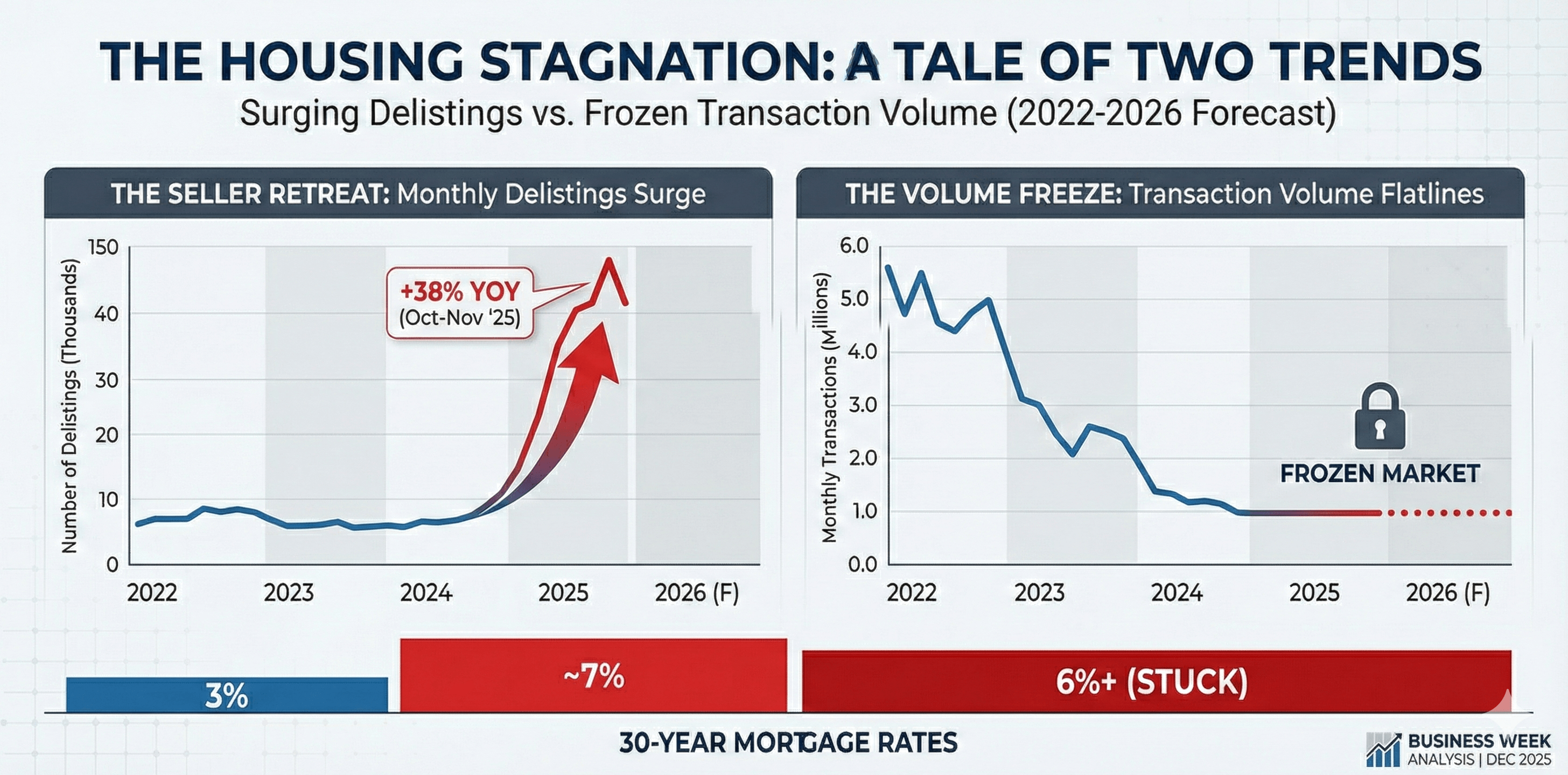
- The Delisting Epidemic: The most damning data point for late 2025 is the surge in delistings. In October and November 2025, delistings (sellers pulling homes off the market without selling) jumped nearly 38% year-over-year. Sellers are testing the market, realizing they cannot get their "make me move" price, and retreating.
- The "Silver Tsunami" Overhang: Baby Boomers currently hold approximately 40% of all U.S. housing wealth (roughly $19 trillion). The Seeking Alpha report highlights a looming structural shift: as this generation ages, a significant wave of supply must eventually hit the market. However, Boomers are currently "aging in place," creating a bottleneck that distorts supply dynamics.
- Affordability Lock-Out: With 30-year mortgage rates stabilizing between 6.2% and 6.7% (and unlikely to drop below 6% in 2026), affordability remains near record lows. The "lock-in effect" is real: 80% of mortgage holders have rates below 5%, discouraging them from listing their homes and trading up.
The Economic Context: Why Now?
The broader economy is exacerbating this stagnation. We are seeing a "weakening labor market" and "slower growth" forecasts for 2026. In uncertain economic times, big-ticket transactions like home purchases are the first to be delayed. Furthermore, the "Pandemic Boomtowns" (Austin, Miami, Nashville) are now becoming the epicenters of this cooling, facing the steepest inventory pile-ups and price corrections as the "work-from-anywhere" premium evaporates
Sector-by-Sector Business Impact
1. For Real Estate Agents: "The Thinning of the Herd"
The business of being an agent is arguably facing the most "misery" of all.
- Volume Crisis: Agents get paid on transactions, not home values. With sales volume largely flat and predicted to rise only a modest 3-4% in 2026 (from historic lows), the pie is too small to feed the current population of agents.
- Commission Compression: Following the NAR settlement and market shifts, buyer agent commissions have compressed from ~2.5% to averages closer to 2.17% for high-end homes.
- The Bottom Line: Expect a mass exodus of part-time and low-production agents. Only those who can master the "delisting conversation"—convincing unrealistic sellers to price correctly—will survive.
2. For Home Buyers: The "Waiting Game"
For buyers, "misery" is defined by a lack of good options.
- The Affordability Ceiling: Even with more inventory appearing, monthly payments remain prohibitively high. Buyers are being forced into "Refuge Markets"—more affordable cities in the Midwest (like Cleveland, St. Louis, and Grand Rapids)—while being priced out of coastal and Sunbelt metros.
- New Construction Limits: Builders are pulling back on single-family starts (projected to be the slowest year since 2019) to avoid oversupply, meaning buyers cannot rely on new homes to save them from high prices.
- Strategy: The savvy move for 2026 buyers is aggressive negotiation on "stale" listings (homes on the market 60+ days) rather than waiting for rate cuts that may not arrive.
3. For Home Sellers: The "Reality Check"
The era of putting a sign in the yard and getting multiple offers over the asking price is over.
- Loss of Pricing Power: The 38% spike in delistings proves that the market rejects current pricing. Sellers who need to sell (due to job loss, divorce, or relocation) will be forced to cut prices, setting new, lower comps for their neighborhoods.
- The "Pandemic Hangover": If you own in a city that boomed during COVID (e.g., Florida or Texas markets), you face the stiffest headwinds. Rising insurance costs and property taxes in these areas are scaring off buyers, leading to inventory gluts.
- Advice: If you don't have to sell, you likely won't. If you do, you must price ahead of the market—undercutting the competition is the only way to generate liquidity in a frozen market.
Conclusion: The "Albatross" Economy
The Seeking Alpha report describes the housing sector as an impending "albatross" for the U.S. economy. This is apt. Housing activity drives everything from Home Depot earnings to furniture sales to moving truck rentals. If the housing market remains "miserable"—stuck in this low-volume, low-affordability loop—it will act as a significant drag on U.S. GDP growth throughout 2026.
The Verdict: We aren't heading for a crash; we are heading for a grind. The "misery" ahead is a slow, frustrating return to normal after a decade of easy money.
Know someone who should read this?
Dive into our quick-start guides for Business, Enterprise, and Partner users—see how easy it is to grow faster, connect better, and dominate your market!